
Floral cover-up: what's possible, what isn't
Covering an old tattoo with a colored floral piece requires precise reading. Criteria, examples, limits.
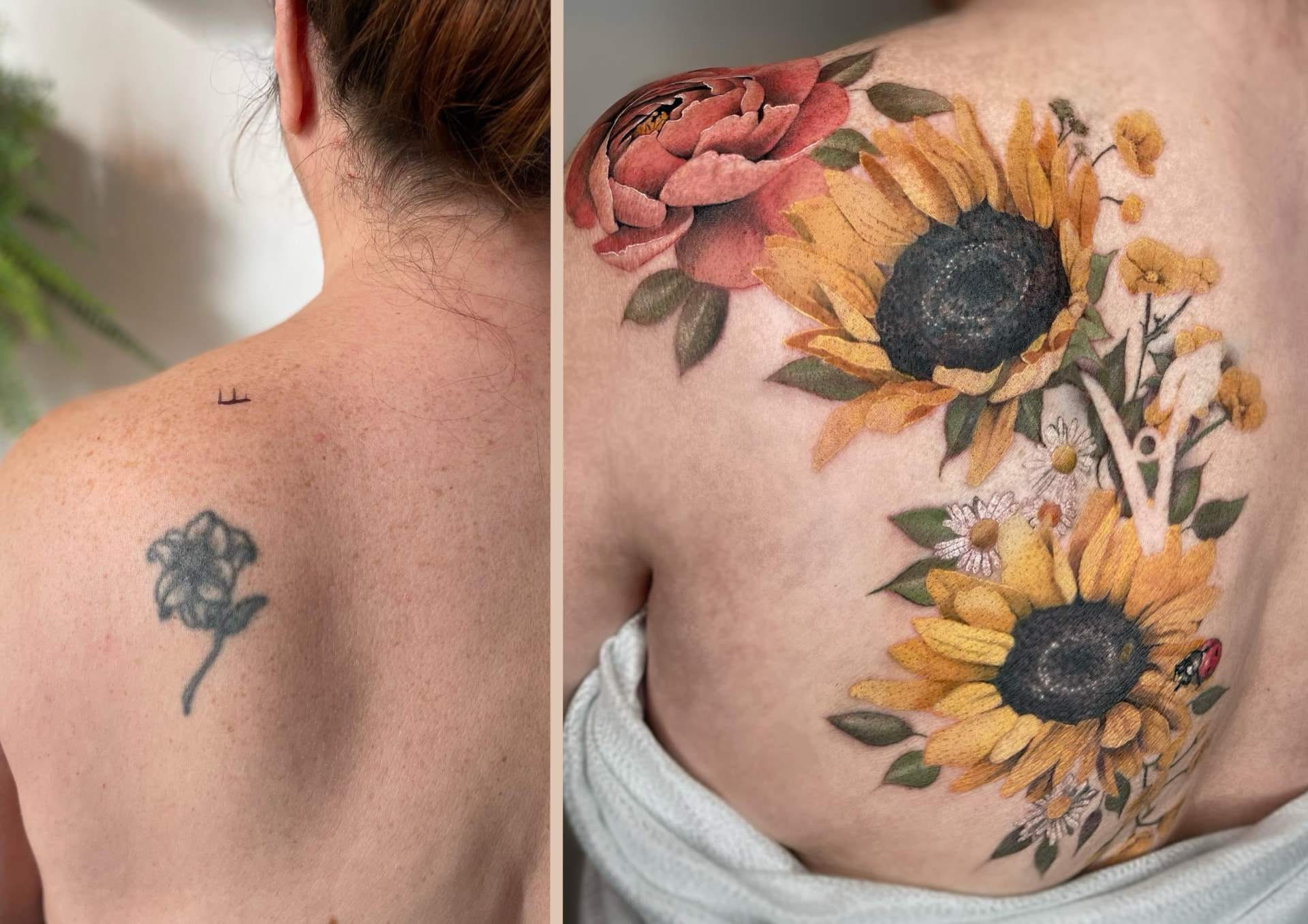
Cover-ups are probably the most complex requests a tattooer gets. A good cover doesn't erase the old piece: it transforms it so you no longer see it. Here's how I read a project.
What makes a cover easy
A thin, not-too-black line. A small to moderate surface. An anatomical zone that welcomes a floral (arm, thigh, back, rather than a tiny wrist). Skin that hasn't been overworked (no multiple retouches).
What makes a cover hard
A dense black tribal. A thick saturated lettering. A tattoo less than six months old. Skin damaged by aggressive earlier sessions. A very small zone that leaves no room to compose a proper flower.
What makes a cover impossible
A fully solid black tattoo on a large surface: you cannot paint blacker than black. Laser removal will be needed first.
Laser as preparation
Some projects need laser tattoo-removal sessions. The number of sessions and healing intervals are assessed individually.
The design
A floral cover-up generally needs about three times the size of the original tattoo. I show you the space needed with a sketch. It uses darker zones (leaves, peony shadows, Art nouveau frames) to absorb the darkest parts of the previous tattoo.
Prior study
For every cover request I need two photos: the tattoo flat and naked, and the tattoo on naturally tensed skin. Without both images I cannot judge.
See examples
Real floral cover-ups are visible in /en/styles (filter "Cover-up") and detailed on /en/cover-up.